
New Year, New Financial Plan: Smart Moves for Crew in 2026
The start of a new year is full of potential and opportunity to improve your financial health. At the same time, it is fraught with risks that will undermine you before you’ve even started. Here’s our yacht crew budgeting guide to help you adopt stronger budgeting, investment and insurance habits for 2026, so that you end the year better off than you started it.
In the Caribbean cyclone or in in-between decision mode?
First of all, where are you starting 2026? That’s going to have a big impact on what you can do now to set yourself up for financial success this year.
Are you in the thick of the Caribbean season, completely immersed in providing the best on-board experience for a string of guests? Or are you quietly waiting out the winter months until the start of the 2026 Mediterranean season? Maybe you’re on rotation, enjoying time at home before you’re dropped into the Caribbean maelstrom in a few weeks’ time?
If you’re on rotation at home or waiting for the Mediterranean mayhem to start (either at home or part of a boat’s skeleton crew), your opportunity to set yourself up for 2026 is right now.
If you are currently off-your-feet busy in the Caribbean, you are not going to be able to do much for yourself until the season ends. Your opportunity to put things in place to make 2026 a financial success will come towards the end of March and early April. But as long as you take some time before the Med season to take action, you’ll reap the benefits for the rest of the year.
Even better, if you’re working on a charter yacht for the next few months, you should have a healthy pot of guest tips you can use to launch your investment plans in March and April.
But beware. There is a risk that you will be tempted to spend your tips before you even get around to making financial plans. Resist that temptation.
We’re not saying you don’t deserve to spend some of it on yourself after a season’s hard work in the Caribbean. Of course you do. But if you want to end 2026 in a financially better place than you started it, put most of your tips into a savings or investment plan. Then it will continue to benefit you.
Smart yacht crew budgeting moves to make
There are five smart moves superyacht crew can make so that 2026 is a financial success.
1. Set up a savings plan or investment plan

Our recommendation is that you set up a savings or investment plan you pay into every month. That means your fund should be growing in two ways during 2026: regular contributions and investment growth .
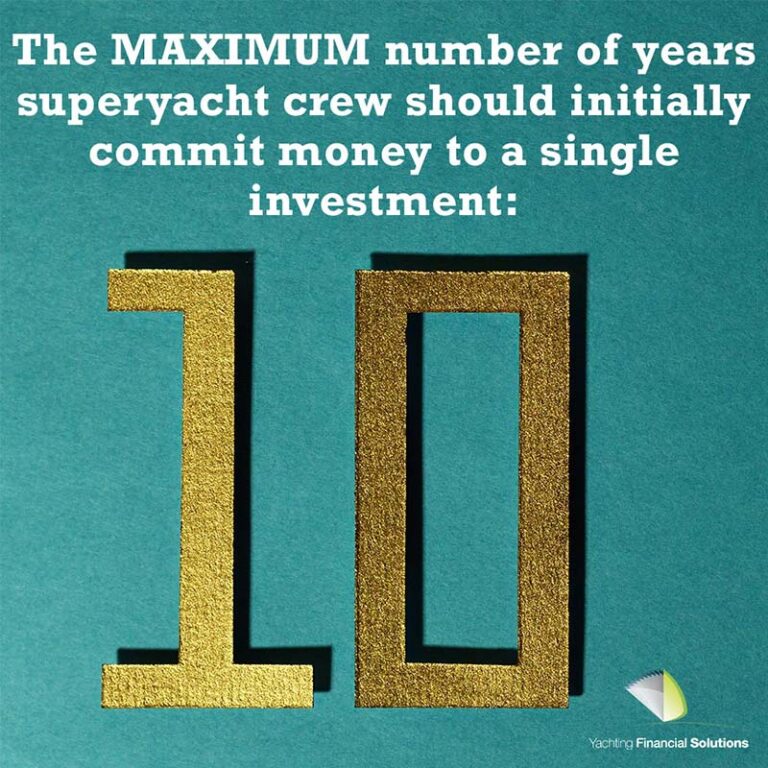
At the very least, you’ll have eight to ten months’ worth of payments by the end of the year. For most yacht crew, that could be as much as USD15,000 to USD20,000. For some, it could even be USD40,000 or USD50,000.
You should have some investment growth on that as well. But let’s be honest, that’s not going to set the world alight come December 2026. To get the most from the growth of your investment, you need to keep funding and your money invested for a few years. It’s time in the markets that is important, not timing the markets. The longer you let investment growth do its job, the more significant this growth will be. 10% growth on an investment of EUR 100,000 is EUR 10,000. 10% growth on an investment of USD 20,000 is USD 2,000. This compounding growth on your investment should allow it to grow exponentially over time.
But if you learn the regular investment habit in 2026, you’ll carry it forward into 2027 and beyond. The longer you keep the habit going, the easier it will become. You’ll draw motivation from the growing value of your savings or investment plan.
2. Buy income protection insurance

Income protection insurance is designed to pay out for a limited time if you are unable to work due to illness or injury. Without it, your monthly income just stops. Can’t work because you got bitten by a dengue-carrying mosquito in Antigua? Sorry, there may be no salary for you. Broke your leg skiing? Same.
No need to worry, though. Income protection pays out money equivalent to your salary or an agreed percentage of your salary until you’re able to go back to work. Your bills are covered and you can keep paying into your savings or investment plan with minimal or no interruption. Having this sort of back-up income is especially important for crew with dependents or monthly commitments like mortgage payments.
Set this up properly at the start of 2026 and you’ll only have to do a quick review annually to make sure it still meets your needs.
3. Get proper medical cover

We recently wrote in-depth about medical cover here: Seasonal Insurance Checks for Superyacht Crew. So we won’t repeat ourselves, other than picking out these highlights:
- Make sure you have adequate healthcare cover on and off the yacht, don’t just rely on what the boat offers.
- If you’re in the Caribbean a lot, make sure your medical cover includes treatment in US medical centres.
- Make sure you understand the excess, shortfall and ceilings of the cover.
- Know how treatment bills will be settled: directly through the insurer or will you have to front up the money and claim it back?
Medical insurance can feel a bit overwhelming. Policies can be dense and contain long lists of treatments, clauses and limits. We can help simplify the process with medical cover that fits the needs of superyacht crew.
Need some help, contact us now.
4. Disability and life cover
Permanent Disability insurance picks up where income protection leaves off. Income protection is a temporary stopgap, often for a maximum of one or two years. Permanent disability takes care of your longer-term financial security, often in the form of a big lump-sum payment.
Permanent Disability cover is often sold in combination with life cover, which pays out a lump sum to your beneficiaries if the worst happens to you.
If you have dependents, this is a vital safety net.
Do it at the start of 2026 and you’ll know that for the rest of the year, and for as long as you keep the cover in place beyond that, your loved ones are financially secure if you lose your ability to earn.
5. Learn to pay yourself first

If you want to manage your money successfully, you need to be selfish. You need to learn to pay yourself first.
What do we mean by that?
Well, from the moment your salary hits your account at the end or at the beginning of the month, a long queue of people forms who would like you to pay them. Eating out? Pay the restaurant. Having a coffee? Pay the café. Drinks with friends or crew mates? Pay the bartender. Tempted by the latest Apple gadget? Tim Cook is only too pleased to take your debit card details.
The queue is long and you may well run out of money before you get to the end of it.
Worse still, it starts all over again next month.
But you can beat the queue. And it’s incredibly easy to do.
Pay yourself first. In other words, pay your investment / savings plan contributions as soon as you are paid. Set up a direct debit or other automated payment, so you don’t even have to think about it. It just happens, month after month.
If you do that, you’ll know that you can spend what’s left, happy in the knowledge that the queue won’t take all your money off you.
How much you should pay yourself first depends on you. If you were to keep USD 1,500 for yourself to spend on treats every month, you’d have far more to spend than most people who work ashore. And you’d be putting at least USD 1,000 per month aside. In fact, if you’ve been in yachting for a while, it’ll be much, much more.
If there is one habit you adopt in 2026, make it paying yourself first.
Your 2026 window of opportunity is limited
If you do these five things, you’ll be in a better financial place going into 2026 than the vast majority of superyacht crew. And you’ll end the year considerably better off financially.
But you do have to take action.
And the clock is ticking.
Realistically speaking, you have until the end of April. Then the window will shut until the end of the Mediterranean season in September. Figuratively speaking, that is. Of course you can take any of the five steps at any point in the year. But we all know that once you’re on board, your priorities are no longer your own. They are the boat’s and the guests’.
How to overcome procrastination in 2026
The biggest hurdle to improving your financial habits in 2026 will be procrastination.
We’re betting that when you read “you have until the end of April,” you thought to yourself, “Oh, plenty of time. No rush, then.”
That’s only human. We get it. But it is the biggest risk to your hopes of improving your financial life in 2026.
At the start of 2025, yacht crew everywhere will have promised themselves they were going to invest more, budget better and put protections in place. Maybe you were one of them? Yet the vast majority didn’t do anything. Not because they didn’t want to, but because procrastination got hold of them.
So how do you avoid that?
By taking simple action that commits you to your goal.
Our advice? Book a call with us, or with any other reputable financial planner. It’s easy to do and it puts a commitment in your diary.
WARNING: all you’ve done is make a commitment. You haven’t actually taken action yet. It’s a first step towards taking action. Only when your savings plan or insurance cover is in place can you say, “I took action.”
If you commit now to having a conversation, you’ll have an excellent chance of completing the action you want to take by the end of April. So get that call in your diary for the earliest date possible.
If you’re ashore now, have the call now.
If you’re reading this in the midst of the Caribbean whirlwind, book the call now for some time in March or early April, so it’s there.
Your commitment to making the call is your commitment to yourself and to a financially successful 2026.